Cleaner job description: what the work actually involves
Duties by setting, the jargon adverts use, and the skills that actually decide whether you are good at this job.
A cleaner's job is to bring a space back to an agreed standard on a schedule: emptying bins, wiping touch points and surfaces, cleaning washrooms and kitchens, and vacuuming and mopping floors, with the exact list set by a written specification. Duties vary sharply by setting; an office clean and a hotel room service are different jobs. Most roles are part-time shifts paying at least £12.71 an hour from April 2026, and the work is genuinely physical.
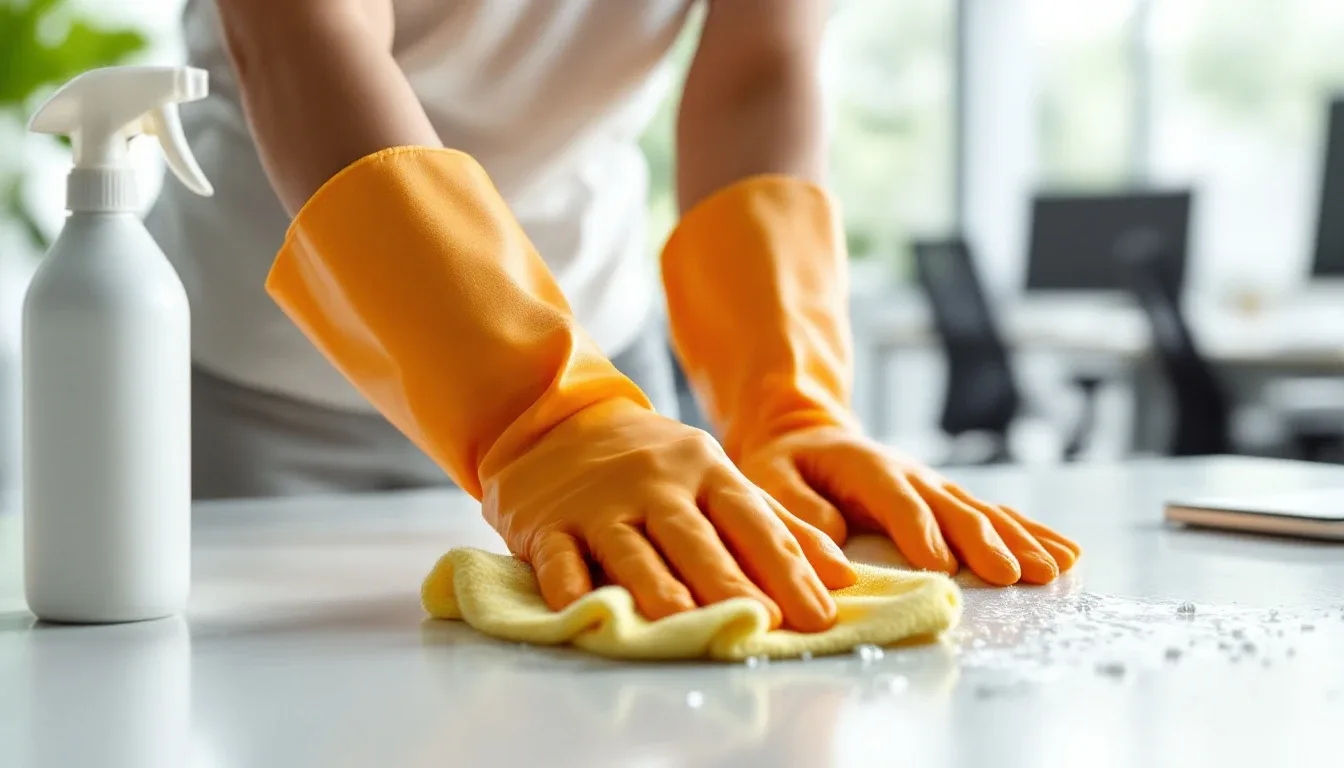
Desk wipe-down with microfibre and spray, the bread and butter of office work.
What does a cleaner actually do?
Strip away the setting and most cleaning jobs run on the same repeating cycle: clear waste and empty bins, wipe the touch points (door handles, switches, phones, rails), clean surfaces and desks, do the washrooms and kitchens properly, then finish with floors, vacuuming carpet and mopping hard surfaces. In commercial work that cycle is written down as a specification, the task list agreed with the client that says what gets done and how often. You are measured against the spec, not against your own taste, which is a relief once you understand it: the job has a defined finish line every shift.
On top of the daily cycle sit periodics: scheduled deeper tasks like carpet extraction, high dusting, window frames or floor buffing, done weekly, monthly or termly. Adverts that mention "periodic deep cleans" mean these. The mix of daily and periodic work is what separates a two-hour office shift from a full-time multi-site role.
Duties by setting
The same core cycle stretches into quite different jobs depending on where you do it. The table gives the honest shape of each; the linked boards show live vacancies.
| Setting | Core duties | What is different |
|---|---|---|
| Office and commercial | Desks, touch points, bins, kitchens, washrooms, floors | Out-of-hours shifts, tight spec, empty building |
| Domestic | Kitchens, bathrooms, dusting, floors, sometimes ironing | Daytime, usually solo, the client's standards apply |
| School | Classrooms, halls, toilets, floors at scale | Term-time contracts, after-school shifts, enhanced DBS arranged by the employer |
| Hotel housekeeping | Strip and make beds, bathroom, dust, hoover, restock | Per-room targets, typically 15 to 25 rooms a shift |
| End of tenancy | Full deep clean: ovens, limescale, inside windows, skirting | Checkout standard, team days, often paid per property |
| Sparkle / builders clean | Plaster dust, paint spots, protective film, glass | Construction sites, deadline pressure, sometimes a CSCS card |
| Hoarder and specialist | Clearance plus deep clean, waste handling in full PPE | Training provided, discretion essential, adverts commonly £13 to £16/hour |
Two of these deserve their own reading if they interest you: our guides tosparkle cleans andhoarder cleaning work describe those days in full, and theend of tenancy guide covers the checkout standard and per-job pay maths. Technician niches sit slightly apart: oven cleaning, for instance, is van-based appliance work with its own training, closer to a trade than to general cleaning.
The advert jargon decoder
Cleaning adverts lean on abbreviations that mean less than they appear to. Here is what they are actually telling you.
| Term | What it means in practice |
|---|---|
| BICSc (or BICS) | The British Institute of Cleaning Science, the industry training body. "BICSc trained" means formal task training, which the employer provides. Not an entry requirement. |
| COSHH | The chemical safety regulations. "COSHH awareness" means using products safely and never mixing them. Training is given on the job. |
| Keyholder | You open or lock up the building and may set the alarm. A trust role that often carries a small pay premium. |
| Mobile cleaner | You cover several sites in a shift, so a driving licence is required. Mobile roles usually pay above single-site rates. |
| TUPE | The transfer rules that move staff to the new contractor, on existing terms, when a building changes cleaning supplier. In practice: your job usually survives a contract change. |
| Colour coding | Cloths and mops assigned by area, so washroom kit never touches kitchen surfaces. Standard practice everywhere; you learn it in week one. |
| Lone working | You clean alone, often in an empty building, with check-in procedures instead of a supervisor on site. |
| Periodics | Scheduled deep tasks outside the daily routine: carpets, high dusting, buffing. |
| Specification / spec | The written task list that defines the standard for the contract. Your job, precisely stated. |
Two of these have real weight behind them. COSHH is law, not branding: the Control of Substances Hazardous to Health Regulations require employers to control chemical risks and train the people using the products2. And TUPE matters more in cleaning than in almost any other sector, because contracts change hands constantly; the rules protect your employment terms when they do3.
- The repeating core cycle
- Bins, touch points, surfaces, washrooms, floors
- Legal pay floor, 21 and over
- £12.71/hour
- Typical office shift length
- 2 to 3 hours, early or evening
- Typical hotel workload
- 15 to 25 rooms per shift
- Training
- On the job, COSHH included
Which skills actually matter?
Not the ones HR templates list. The skill the whole industry runs on is reliability: buildings are cleaned by people working unsupervised at 5am, and a cleaner who turns up every shift is worth more to a supervisor than a fast one who sometimes does not. Second is working to the spec rather than to your own preferences, doing the tasks on the list to the agreed standard even on the days nobody would notice a shortcut.
After those: pace with consistency, because most roles give you a set area in a set time and the good cleaners hit it every day rather than occasionally; discretion, since the job puts you in people's homes, offices and confidential spaces, often holding their keys; and plain communication, reporting the leak, the broken tile or the empty stockroom instead of cleaning around it. None of this needs a certificate. All of it shows up in references, which is why getting your first cleaning job depends on them more than on any qualification.
How physical is the job?
Honestly physical, and adverts undersell it. You are on your feet for the entire shift, bending to bins and skirting, reaching above shoulder height, pushing a vacuum or a mop for hours, and in hotel and end of tenancy work doing it against the clock. Musculoskeletal strain is the sector's main health risk, which is why decent employers train manual handling and provide equipment that reduces lifting, in line with HSE guidance4. Gloves are standard because chemicals and hot water are hard on skin.
The adjustment takes a couple of weeks and then the work simply keeps you fit. People who thrive in cleaning tend to say the same two things: you see the result of your work immediately, and the shift ends when the spec is done, not when a meeting overruns. If your feet ache in week one, that is normal. Buy the good shoes.
How the work is checked
Commercial cleaning is audited. Supervisors score sites against the specification, clients do walk-rounds, and hotels check rooms before guests reach them. It sounds like pressure but mostly works in your favour: the standard is written down, so a dispute about whether something is clean has an answer, and consistently good audit scores are what get cleaners moved into keyholder, team leader and supervisor roles. Every employed role also sits on the statutory floor of £12.71 an hour for over-21s from April 20261; for what each niche pays above that, seeour salary guide, or go straight to thelive job boards and read today's adverts with this page as the translator.
Questions people ask
What are the main duties of a cleaner?
The repeating core in most settings: empty bins, wipe touch points and surfaces, clean washrooms and kitchens, then vacuum and mop floors. The exact list comes from a specification agreed with the client, plus periodic tasks like carpet cleaning or high dusting on a schedule. Duties then vary a lot by setting; a hotel room attendant's shift looks nothing like an office cleaner's.
What does COSHH mean in a cleaning job advert?
COSHH stands for Control of Substances Hazardous to Health, the regulations covering safe use of cleaning chemicals. When an advert asks for COSHH awareness it means knowing how to use, dilute and store products safely and never mix them. Employers provide the training; you are not expected to arrive with a certificate.
Is cleaning a hard physical job?
It is honest physical work. You are on your feet for the whole shift, with repeated bending, reaching and lifting, and hotel and end of tenancy roles add time pressure on top. Most people adjust within a couple of weeks, and good shoes matter more than gym fitness. If you like seeing immediate results and dislike sitting at a desk, the physicality is a feature, not a flaw.
What is the difference between a cleaner and a housekeeper?
Mostly the setting. A cleaner works to a specification in offices, schools, homes or sites, usually while the space is empty. A housekeeper works in hospitality or a private household, servicing rooms that are in use, making beds, restocking and presenting the space as well as cleaning it. Hotel housekeeping runs on per-room targets, which is the biggest practical difference day to day.
- GOV.UK, "National Living Wage increases to £12.71 per hour", gov.uk/government/news/national-living-wage-increases-to-1271-per-hour. Accessed 17 July 2026.
- Health and Safety Executive, "COSHH basics", hse.gov.uk/coshh. Accessed 17 July 2026.
- GOV.UK, "Business transfers, takeovers and TUPE", gov.uk/transfers-takeovers. Accessed 17 July 2026.
- Health and Safety Executive, "Musculoskeletal disorders at work", hse.gov.uk/msd. Accessed 17 July 2026.
Last reviewed 17 July 2026. Duties change little year to year; the pay figures and regulations are checked against the sources above.