How to start a cleaning business in the UK
The practical route from cleaning for an employer to running your own book of clients, with the legal bits described in plain English.
You start a cleaning business in the UK by picking a legal structure (most people begin as sole traders), telling HMRC, buying public liability insurance (advertised from around £5 a month) and pricing your first jobs. No licence is needed for general cleaning. The hard part is not the paperwork, it is winning clients: letting agents' overflow, local recommendations and reliable quality build a round faster than any advert. Hiring staff brings legal duties, including employers' liability insurance.
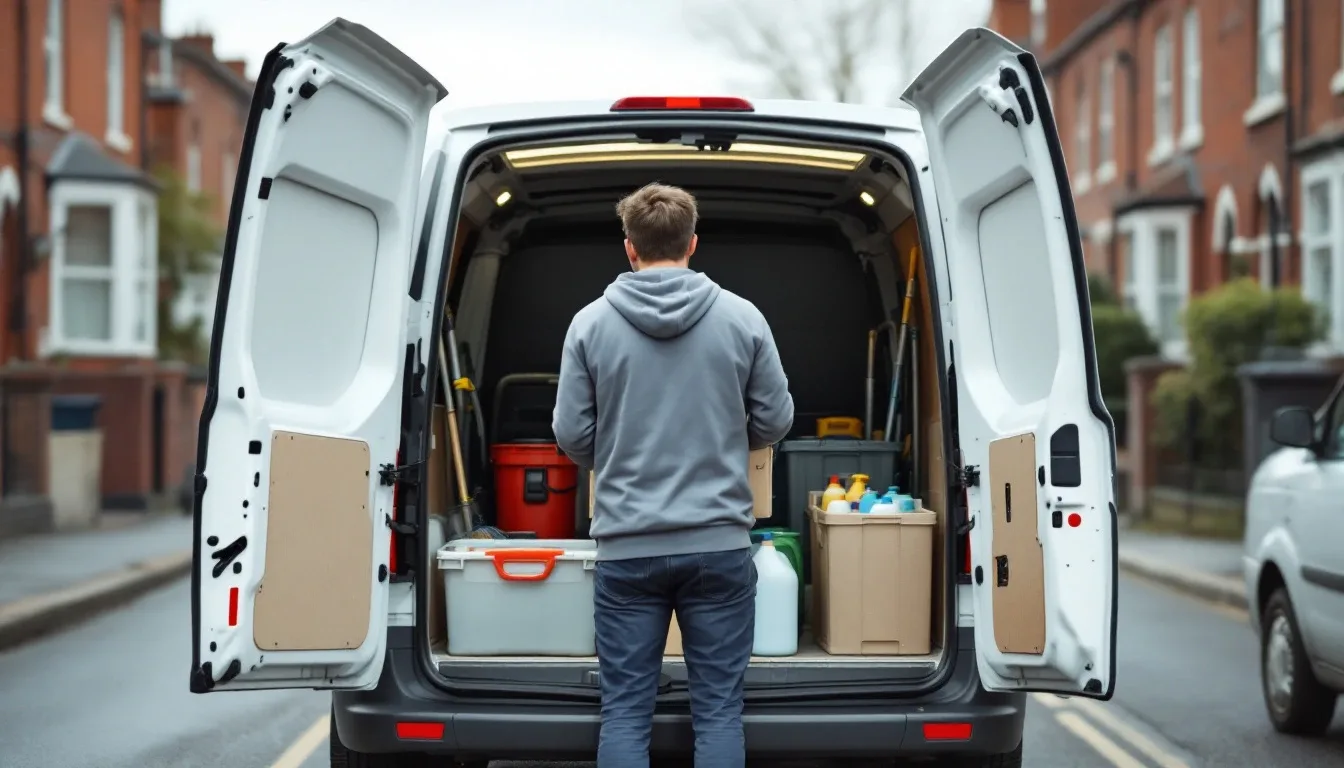
Loading the van outside the first job: bucket, crates and mop handles in the back.
Do you need qualifications or a licence?
For general cleaning, no. There is no licence, no mandatory qualification and no registration body standing between you and your first paying client. What replaces them is reputation: in this trade your references, your reviews and your reliability are the credentials, and clients check them harder than any certificate.
A few edge cases are worth knowing before you pick a niche. If you carry waste away from jobs, common in void clearances and hoarder work, you must register as a waste carrier with the Environment Agency; gov.uk explains the process. Window cleaners in Scotland need a licence from their local council under the Civic Government (Scotland) Act, a quirk that does not apply to general cleaning or to window cleaning in England and Wales. And if you want commercial contracts, buyers will often ask about COSHH awareness, the health and safety rules for chemicals at work6. None of this stops you starting with domestic clients this month.
Sole trader or limited company?
A business needs a legal shape, and in the UK there are two realistic options for a cleaning firm. As asole trader you and the business are the same legal person: you register with HMRC, keep records of income and expenses, and pay tax on profits through Self Assessment. Setting up is free and the admin is light, which is why most one-person cleaning businesses start this way. The step-by-step process is on gov.uk1.
A limited company is a separate legal entity registered at Companies House. The company owns the contracts and the debts, files annual accounts, and pays Corporation Tax; you are paid as its director and shareholder. That separation matters more as contracts, staff and risk grow, and some commercial clients prefer dealing with a company, but it comes with real filing obligations. Again, gov.uk describes the whole route2.
Which structure fits depends on your scale, your appetite for admin and how you want to pay yourself, and that is a decision to make with gov.uk's guidance or an accountant, not a careers website. Plenty of cleaning businesses start as sole traders and incorporate later once the diary is full. Tax returns themselves are beyond this guide on purpose: HMRC's own Self Assessment pages are the reliable source for how and when to file.
What insurance does a cleaning business need?
Public liability insurance is the one to buy before your first job. It covers injury to other people and damage to their property, the burst pipe behind the washing machine, the bleach mark on the carpet, and cleaning policies are advertised from around £5 a month, with typical annual premiums of roughly £50 to £100 for £1 million to £2 million of cover. It is not a legal requirement for a business with no staff, but domestic clients increasingly ask for it and letting agents and commercial buyers will not use you without it.
Employers' liability insurance is different: it becomes a legal requirement the day you take on staff, with at least £5 million of cover from an authorised insurer, and you can be fined up to £2,500 for every day you are not properly insured3. Worth knowing about before you promise a friend some shifts.
Two extras that matter in this trade: keys cover, for lost or copied client keys and the lock changes that follow, and treatment risk cover, for damage to the actual item you are working on, which standard public liability policies often exclude. Ask the insurer directly rather than assuming.
- Licence for general cleaning
- None required
- Public liability insurance
- Advertised from about £5/month
- Employers' liability (once you hire)
- £5m minimum, legally required
- Typical domestic charge-out
- £15 to £20/hour
- VAT registration threshold
- £90,000 rolling turnover
How to price cleaning jobs
Domestic cleaning is normally priced by the hour, and the going range for self-employed cleaners is£15 to £20 an hour across most of the UK, £15 to £25 in London. Price from your costs up, not from the employed wage down: insurance, products, travel between clients, cancellations and unpaid admin all come out of the headline rate before tax. A cleaner charging at employed-wage levels is paying for the privilege of working. Our salary guide sets out how charge-out rates compare with employed pay once those costs are counted.
One-off work prices better per job than per hour. End of tenancy cleans, ovens, carpets and builders cleans are all bought as outcomes: the client cares that the checkout report passes, not how long you took. Quote the job, state what is included in writing, and let your speed become your margin. Experiencedend of tenancy teams beat hourly equivalents this way, and the same logic drives the oven cleaning trade. Check what local competitors publish before you set numbers, then resist the urge to be the cheapest: in cleaning, the cheapest quote reads as the riskiest one.
Winning your first clients
Letting agents are the most reliable early source of work. Every branch has more end of tenancy and void cleans than its regular firms can absorb at month end, and agents will trial an unknown cleaner on overflow work long before a householder will. Walk in, leave a card, say you can cover short-notice jobs. Do three well and you are on the list they actually call.
For domestic regulars, local beats clever. Post in the community Facebook groups for the streets you want to work, put simple cards through doors in the same few roads, and ask every early client for a recommendation once you have cleaned for them a month. Density is the quiet win: five clients within walking distance of each other earn more per day than eight scattered across town, because travel time is unpaid. A free Google Business Profile with a handful of honest reviews does more than paid adverts at this stage, and paid lead platforms are better left until you know your numbers. Watch the fakes while you advertise: anyone offering to overpay you by cheque is running a scam, not booking a clean. Ourjob scams guide covers the patterns.
Equipment basics
Start smaller than the shopping list in your head. A domestic round needs a decent vacuum, a mop and bucket, a caddy of colour-coded microfibre cloths, and a short list of products you trust; many domestic clients prefer you to use their own vacuum and products anyway, which keeps your costs near zero. A polo shirt with your name on it is the cheapest trust signal you can buy.
A van becomes necessary when the work does: end of tenancy and builders cleans mean carrying a full kit, steps and sometimes a carpet machine between properties. Store chemicals sensibly, keep the data sheets that come with trade products, and read the basics of COSHH on the HSE site6; it is written for employers but the safe-handling logic applies to a one-person firm too.
When to take on help
The trigger is a full diary: when you are turning down work every week, the choice is to raise prices, or add hands. Some cleaners pass overflow to another self-employed cleaner they trust. If instead someone works for you, to your rota and under your control, employment law will likely treat them as your employee whatever the paperwork says, and HMRC has a status tool for exactly this question.
Employing people is a step change in obligations. You register as an employer with HMRC and run payroll through PAYE4, pay at least the National Living Wage of£12.71 an hour for staff aged 21 and over, enrol eligible staff into a workplace pension, and hold the employers' liability cover described above. None of it is a reason not to grow, most local cleaning firms started exactly here, but walk in with your eyes open and gov.uk bookmarked.
Growth has one more tripwire: VAT. Once your rolling 12-month turnover passes £90,000 you must register for VAT5, which changes your pricing overnight for domestic clients who cannot reclaim it. Firms near the threshold plan for it rather than discovering it. If running staff sounds like more business than you want, the one-person version is a fine place to stay: our self-employed cleaner guide covers rates, insurance and building a round in detail.
Questions people ask
Do I need a licence to start a cleaning business in the UK?
No licence is needed for general domestic or commercial cleaning in England, Wales or Northern Ireland. There are edge cases: if you carry away waste as part of the work, for example on clearance jobs, you must register as a waste carrier with the Environment Agency, and window cleaners in Scotland need a licence from their local council.
How much does it cost to start a cleaning business?
A one-person domestic cleaning business can start for a low three-figure sum: public liability insurance is advertised from around £5 a month, a basic kit of vacuum, mop, caddy and cloths costs under £200, and registering as a sole trader with HMRC is free. Costs rise when you need a van, specialist machines or staff.
Do I have to tell HMRC straight away?
You must register for Self Assessment once your gross trading income passes £1,000 in a tax year, and the deadline is 5 October after the end of the tax year in which you started. Below £1,000 the trading allowance can cover it. The rules are described on gov.uk, which is the place to check your own position.
Can I run a cleaning business from home?
Yes, and almost everyone does at the start. The work happens on clients' premises, so your home is the office and the store cupboard. You will want somewhere to keep chemicals away from children and pets, and business insurance for kit kept in a vehicle overnight is worth checking when you get a van.
- GOV.UK, "Set up as a sole trader: step by step", gov.uk/set-up-as-sole-trader. Accessed 17 July 2026.
- GOV.UK, "Set up a private limited company", gov.uk/set-up-limited-company. Accessed 17 July 2026.
- GOV.UK, "Employers' liability insurance", gov.uk/employers-liability-insurance. Accessed 17 July 2026.
- GOV.UK, "PAYE and payroll for employers", gov.uk/paye-for-employers. Accessed 17 July 2026.
- GOV.UK, "How VAT works: VAT thresholds", gov.uk/how-vat-works/vat-thresholds. Accessed 17 July 2026.
- Health and Safety Executive, "COSHH basics", hse.gov.uk/coshh. Accessed 17 July 2026.
Last reviewed 17 July 2026. Statutory figures checked against the sources above; wage and VAT thresholds change, so verify on gov.uk before acting.