Self-employed cleaner: rates, insurance and finding clients
Cleaning for your own clients instead of an employer: the money, the paperwork and how a full round actually gets built.
A self-employed cleaner works for their own clients and typically charges £15 to £20 an hourin most of the UK, £15 to £25 in London. You must register with HMRC once the work earns you more than £1,000 in a tax year, and nearly every working cleaner carries public liability insurance, advertised from around £5 a month. The round itself is built on letting agents' overflow, recommendations and a tight travel patch.
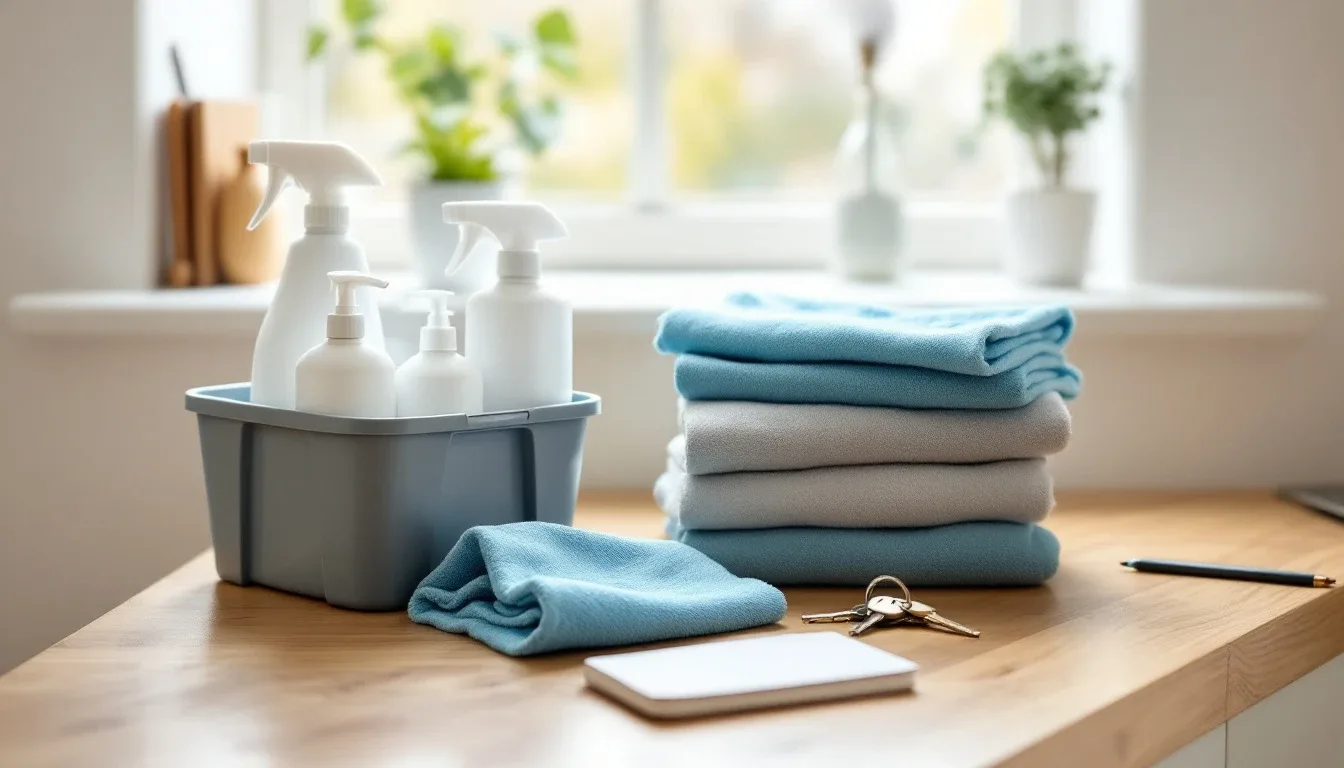
The self-employed basics: caddy, cloths, client keys and the notebook.
What changes when you go self-employed?
An employed or agency cleaner gets a wage, holiday pay, sick pay and someone else's insurance. A self-employed cleaner trades all of that for control: you set the price, choose the clients, keep what you charge and carry the risk. Nobody covers you when a client cancels, when you are ill, or when the carpet stains. The deal is better pay per hour in exchange for absorbing the gaps, which is why the move usually comes after time inemployed or agency domestic work, once you know your speed and your standards, not before.
Plenty of cleaners run both at once: an agency or employed contract for the guaranteed base, plus private clients on the side while the list grows. That is a legitimate way in, provided any contract you hold allows it; some agencies restrict taking on their clients privately, and poaching a client you met through an agency is the fastest way to a legal letter.
Registering with HMRC
Working for yourself makes you a sole trader in HMRC's eyes, and the rules are simpler than the reputation suggests. Below £1,000 of gross trading income in a tax year, the trading allowance can cover the lot with nothing to file3. Past that point you register for Self Assessment, with a deadline of 5 October after the end of the tax year in which you started2. HMRC sends a Unique Taxpayer Reference, and from then on you report the year's income and expenses and pay Income Tax and National Insurance through Self Assessment.
This guide stops there deliberately. What you will owe depends on your whole income picture, and the place to work through registration, returns and payment is gov.uk itself, starting with the "Working for yourself" pages1. Registering is free, so treat any site charging a fee to "register you as self-employed" as a middleman you do not need.
- Typical charge-out rate
- £15 to £20/hour (£15 to £25 London)
- HMRC registration trigger
- Over £1,000 gross in a tax year
- Registration deadline
- 5 October after that tax year
- Public liability insurance
- Advertised from about £5/month
- Employed floor, for comparison
- £12.71/hour (21+)
What should you charge?
The going range for self-employed domestic cleaning is £15 to £20 an hour across most of the UK, and £15 to £25 in London. Those are advertised and charged rates, not statute, so check what cleaners in your area publish before setting yours. The employed floor is the useful benchmark: staff aged 21 and over must be paid at least £12.71 an hour from April 20264, and your rate needs to sit well above it because it is doing more jobs. Out of the headline come insurance, products, travel between clients, cancellations and unpaid admin, then tax. As a planning figure, £18 charged tends to resemble £13 to £14 employed once those costs are counted. The full comparison is in oursalary guide.
Two pricing habits protect you. First, quote one-off work per job, not per hour: deep cleans and end of tenancy cleans are bought as outcomes, and a written quote stating what is included beats a vague hourly estimate for both sides. Second, review prices once a year and whenever the diary is full with a waiting list. A full diary at a low rate is not success, it is a queue of underpriced work blocking better-paid jobs.
Public liability insurance
Public liability insurance covers injury to people and damage to property arising from your work: the vase, the bleach splash, the scratched hob. It is not a legal requirement for a cleaner working alone, but it is the norm, clients and letting agents increasingly ask for proof, and it is cheap for this trade: policies for cleaners are advertised from around £5 a month, with typical annual premiums of roughly £50 to £100 for £1 million to £2 million of cover.
Read the exclusions before buying. Standard policies often exclude treatment risk, meaning damage to the very item you are cleaning, and cover for clients' keys in your possession varies. If you later employ anyone, even casually, employers' liability insurance stops being optional and becomes a legal requirement with real fines behind it; that step and the rest of the growing-up paperwork are covered in ourguide to starting a cleaning business.
Cancellations and getting paid
Cancellations are the tax nobody warns you about. An employed cleaner gets paid when a building is shut; a self-employed cleaner with three cancellations in a week just lost a day's income. The fix is a policy stated before the first clean, in writing: how much notice a cancellation needs (24 or 48 hours is common), what a late cancellation costs, and how client holidays are handled. Regulars accept clear terms without fuss when they are set out at the start. Introduced apologetically after a bad month, they land far worse.
On payment, keep it boring and prompt. Most domestic clients pay by bank transfer on the day; a simple invoice with your name, the date and the amount is enough at this scale. Letting agents and firms pay on invoice terms, sometimes slowly, so agree the terms before the first job and chase politely on the day payment falls due. For large one-off cleans for new clients, a deposit is reasonable and normal. And never accept an overpayment with a request to refund the difference: that is the classic cheque scam described in our job scams guide, and real clients do not do it.
Building a full round
A round is a repeating weekly pattern of clients, and the good ones are built tight. Five clients within walking distance beat eight spread across town, because travel time is unpaid and a compact patch lets you fit an extra clean into the same day. Decide the streets you want to work, then aim everything at them: cards through doors, posts in the local Facebook groups, and a free Google Business Profile that collects honest reviews as you go.
Letting agents are the fastest early source of paid work, because every branch has overflowend of tenancy cleans at month end and will trial a reliable unknown on them. After that, recommendations compound: each happy regular is a referee for the next street over. Expect the first months to be patchy, keep some employed or agency hours until the diary holds, and once it is full, prune. Dropping the client who cancels constantly, or the one a 40-minute drive away, to make room for a better-fit one is how mature rounds quietly raise their hourly rate without raising a single price. If a full diary starts turning into turned-down work, that is the moment to read ourstarting a cleaning business guide, because taking on help changes the rules.
Keeping records
HMRC requires the self-employed to keep records of income and expenses, and to hold onto them for at least5 years after the 31 January filing deadline of the tax year they belong to5. At one-cleaner scale this is not an accounting system, it is a habit: log every payment received, keep receipts for products, kit and insurance, and note business mileage as you go. A spreadsheet updated weekly, or any of the simple bookkeeping apps, is plenty. The habit pays twice, once at tax time and once whenever you need to prove your income for a tenancy or a mortgage, which is a moment self-employed cleaners meet sooner or later.
Questions people ask
How much should I charge as a self-employed cleaner?
Typical advertised rates for self-employed domestic cleaners are £15 to £20 an hour across most of the UK, and £15 to £25 in London. Charge within the local range rather than under it: your rate has to cover insurance, products, travel and cancellations before tax, which an employed wage does not.
Do I need insurance to clean houses?
Public liability insurance is not a legal requirement for a cleaner working alone, but almost every working cleaner carries it. It covers accidental damage and injury claims, clients and letting agents increasingly ask for proof, and cleaning policies are advertised from around £5 a month. Employers' liability insurance only becomes a legal duty if you take on staff.
Do I need to tell HMRC if I only clean a few hours a week?
Once your gross income from the work passes £1,000 in a tax year, you must register for Self Assessment, with a deadline of 5 October after the end of that tax year. Below £1,000 the trading allowance can cover it. Check your own position on gov.uk, which sets out the rules and the registration steps.
Do self-employed cleaners need a DBS check?
There is no legal requirement for one in ordinary domestic cleaning. Many self-employed cleaners buy a basic DBS check anyway (£21.50, applied for yourself on gov.uk) because it is a cheap trust signal when meeting new clients. School and regulated-activity work is different: there the employer arranges an enhanced check.
- GOV.UK, "Working for yourself", gov.uk/working-for-yourself. Accessed 17 July 2026.
- GOV.UK, "Register for Self Assessment", gov.uk/register-for-self-assessment. Accessed 17 July 2026.
- GOV.UK, "Tax-free allowances on property and trading income", gov.uk/guidance/tax-free-allowances-on-property-and-trading-income. Accessed 17 July 2026.
- GOV.UK, "National Living Wage increases to £12.71 per hour", gov.uk/government/news/national-living-wage-increases-to-1271-per-hour. Accessed 17 July 2026.
- GOV.UK, "Business records if you're self-employed", gov.uk/self-employed-records. Accessed 17 July 2026.
Last reviewed 17 July 2026. Figures checked against the sources above; HMRC thresholds and wage rates change, so confirm on gov.uk before acting.